Writing plans is the easy part.
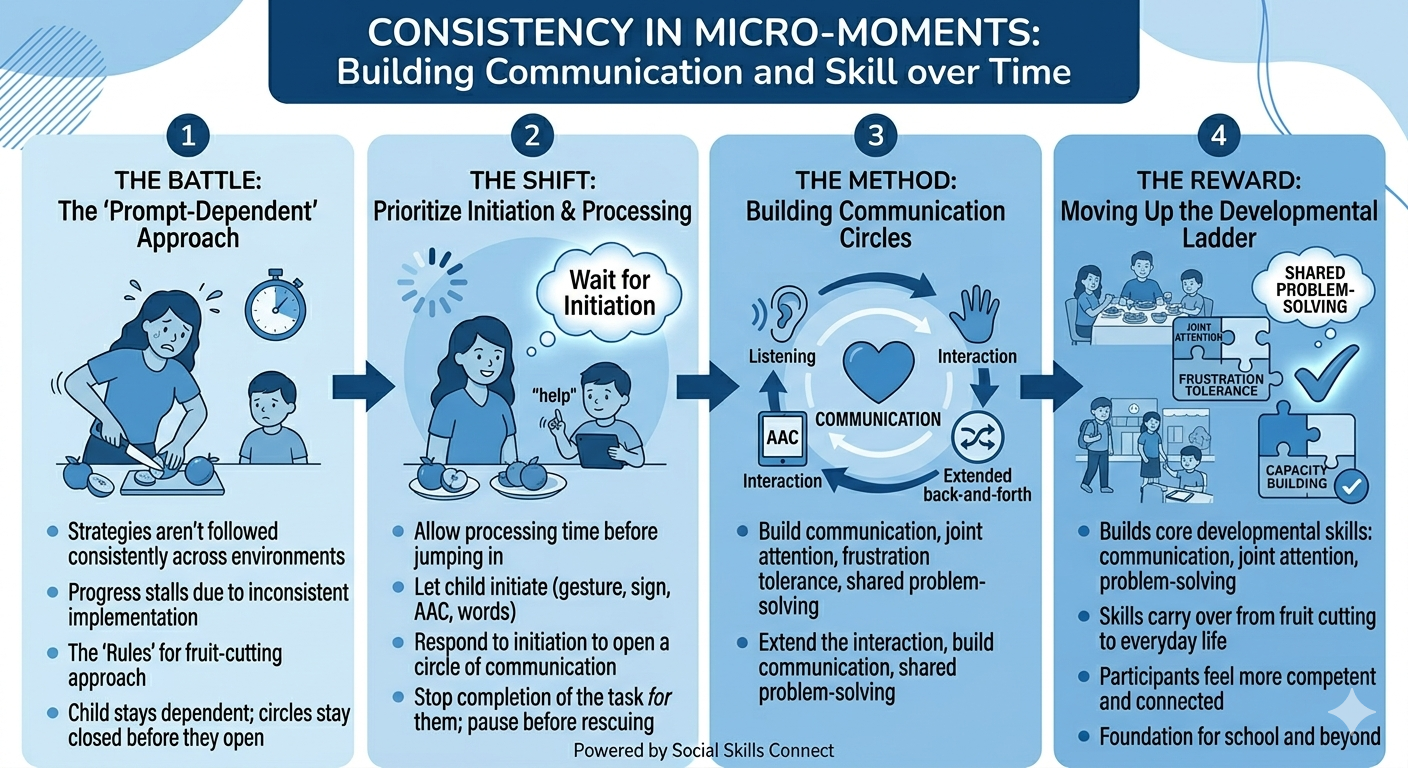
The hard part is watching what happens when strategies are not followed consistently across the environments a child lives in.
We can design thoughtful, evidence-informed approaches. But if they are not implemented by everyone around that child, progress stalls. And that is frustrating, because I have seen what happens when it is done well.
A simple example: cutting up fruit
That moment is not about getting the fruit cut quickly. It is about interaction, initiation, and opening and closing circles of communication.
If we jump in too quickly, prompt every step, or complete the task for them, the child stays prompt-dependent. The circles stay closed before they ever open.
But if we allow processing time, let them problem-solve, pause before rescuing, and wait for them to request help through a sign, AAC, a gesture, or words, something shifts.
They initiate. A circle opens. We respond. The circle closes.
We might pretend to struggle slightly. Work together. Share the goal. Extend the back-and-forth. More circles opening and closing, building on each other.
Now we are not just cutting fruit. We are building communication, joint attention, frustration tolerance, and shared problem-solving. We are moving up the developmental ladder, one circle at a time.
These everyday micro-moments matter.
Consistency matters.